
January 19, 2026
Artificial intelligence is fundamentally changing our working world – but it is not making people redundant. In our daily consulting work, we see how AI primarily creates added value where it complements human strengths: understanding, creativity, judgment, and contextual knowledge. The right AI applications support teams in reducing repetitive tasks, accessing data faster, and making better-informed decisions. At the same time, the role of humans remains central: AI provides suggestions and analyses, but humans decide, weigh, question, and shape. Companies that understand AI as a tool – i.e., as a complement to human work rather than a replacement – succeed in accelerating innovation and securing competitive advantages. Numerous executives from the tech sector expressly emphasize this aspect: AI is a multiplier for productivity and creativity, not an automatic job destroyer. At the same time, the debate about ethical questions, cultural impacts, and new roles remains relevant, because AI changes not only processes but also expectations and work models on a broad scale.
A good example of this perspective is provided by Sam Altman, CEO of OpenAI, who explains that while AI models could take over a large part of daily tasks, this does not necessarily eliminate jobs – rather, the nature of work will change and create new roles.


AI in companies is already breaking records
Based on current studies, the use of AI in companies is growing strongly:
Studies show that 92% of companies want to increase their investments in AI in the coming years, although only **around 1% describe themselves as fully “AI-mature.”
Forecasts assume that the global AI market will grow from around USD 391 billion in 2025 to over USD 1.8 trillion by 2030 (CAGR ~35%).
Gartner analyses suggest that by 2030, around 75% of IT work by humans will be done with AI support and about 25% through autonomous AI processes.
These trends show a progressive integration of AI – not merely as a “replacement,” but as an expanded capability set for humans and organizations.
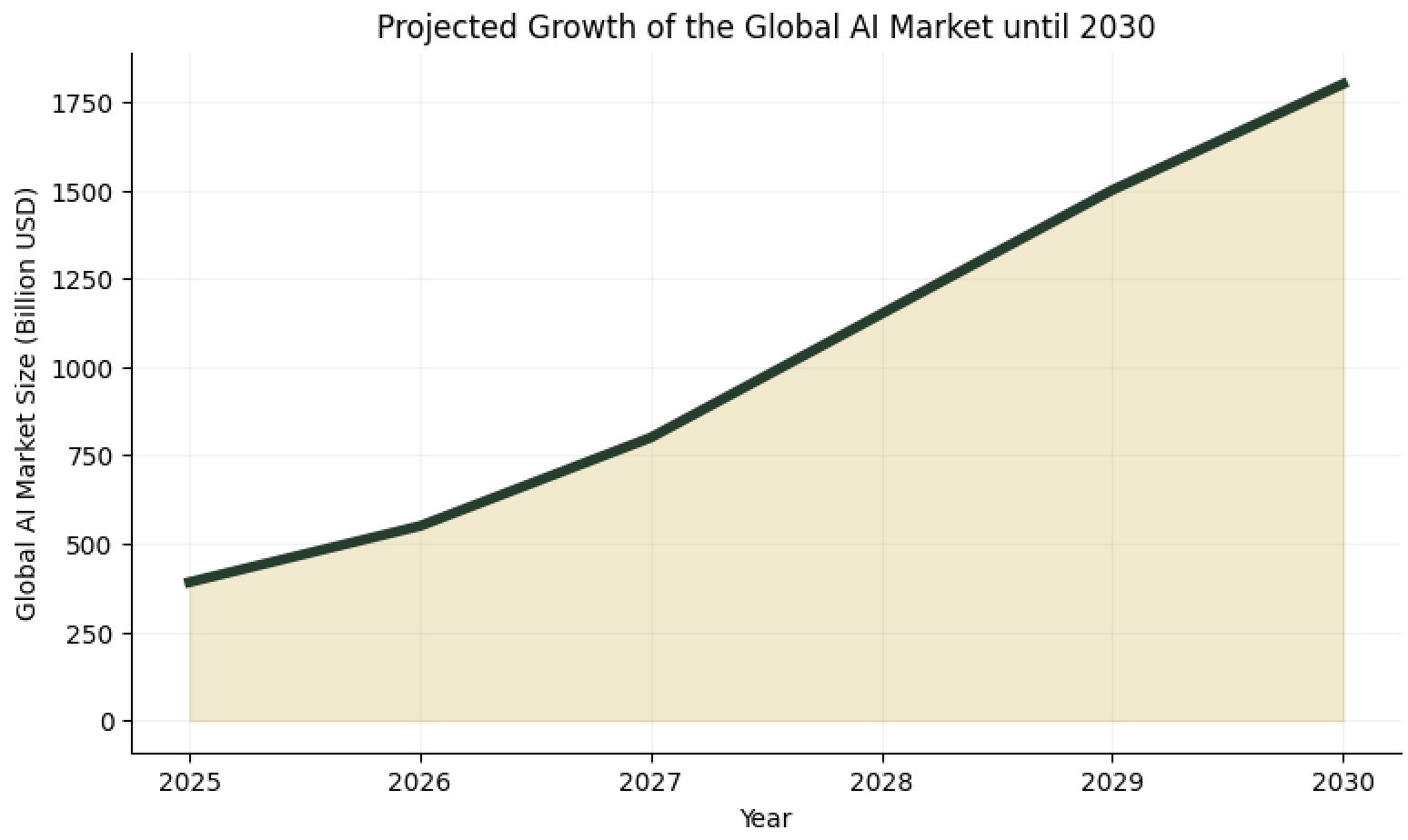
Source: based on McKinsey (2025); Gartner (2025).
AI will replace up to 40% of tasks, not humans… Sam Altman, CEO OpenAI
How AI grows – but work remains human
The successful use of AI does not begin with tools, but with a clear strategic classification. Companies should first develop an AI roadmap that answers where AI provides useful support and where no automation should take place. In practice, this means that business processes are systematically considered and then prioritized according to whether AI saves time, increases quality, or provides better decision-making foundations. A procedure in which use cases are evaluated along criteria such as repetition frequency, decision relevance, data availability, and risk has proven particularly effective. This quickly creates clarity about whether AI brings real added value in research, analysis, preparation, quality assurance, or customer interaction, for example – instead of using “a little bit of AI everywhere” in an uncoordinated manner.
At the same time, upskilling is a central lever that is often underestimated. AI only unfolds its value when employees understand how to classify, improve, and critically question results. Successful organizations therefore invest specifically in practical enablement formats: short workshops on prompting basics, examples of typical work tasks (e.g., analysis, summaries, structuring) as well as simple quality checks for AI outputs. Tools such as ChatGPT, Microsoft Copilot, or specialized analysis assistants are not “explained” in the process, but specifically embedded in existing workflows. The goal is not tool knowledge, but confidence in action: employees know when AI helps, how to achieve better results, and where human evaluation remains mandatory.
A decisive success factor is also the conscious design of human-in-the-loop processes. AI should be used where it makes suggestions, shows options, or condenses information – not where it decides alone. In practice, this means, for example, that AI creates initial analyses, drafts, or summaries, while humans prioritize, interpret, and approve. Especially in sensitive areas such as strategy, communication, HR, or customer service, this interaction creates security, quality, and acceptance. At the same time, it reduces the risk of incorrect decisions, distortions, or blind trust in automated results.
So that AI not only “feels” helpful, but delivers measurable added value, it needs a clear KPI and impact focus. Instead of abstract key figures, companies should measure concrete effects: time saved per task, reduction of rework, faster decision-making cycles, or improved result quality. In many projects, a simple before/after consideration is sufficient to make visible what contribution AI actually makes. This transparency is crucial to create acceptance in management and to further develop investments in a targeted manner.
Last but not least, a clear governance and ethics structure is necessary to use AI sustainably and responsibly. This includes understandable guard rails: Which tools are allowed? Which data may be used? Where are approvals necessary? Successful companies formulate these rules consciously pragmatically – as an orientation, not as an innovation brake. Supplemented by clear responsibilities and regular reviews, this creates a framework that creates trust, reduces legal risks, and at the same time leaves room for productive use.
When used correctly, AI does not become a replacement for human work, but a productive sparring partner that relieves people, supports thought processes, and allows organizations to act faster, better, and in a more well-founded manner.